
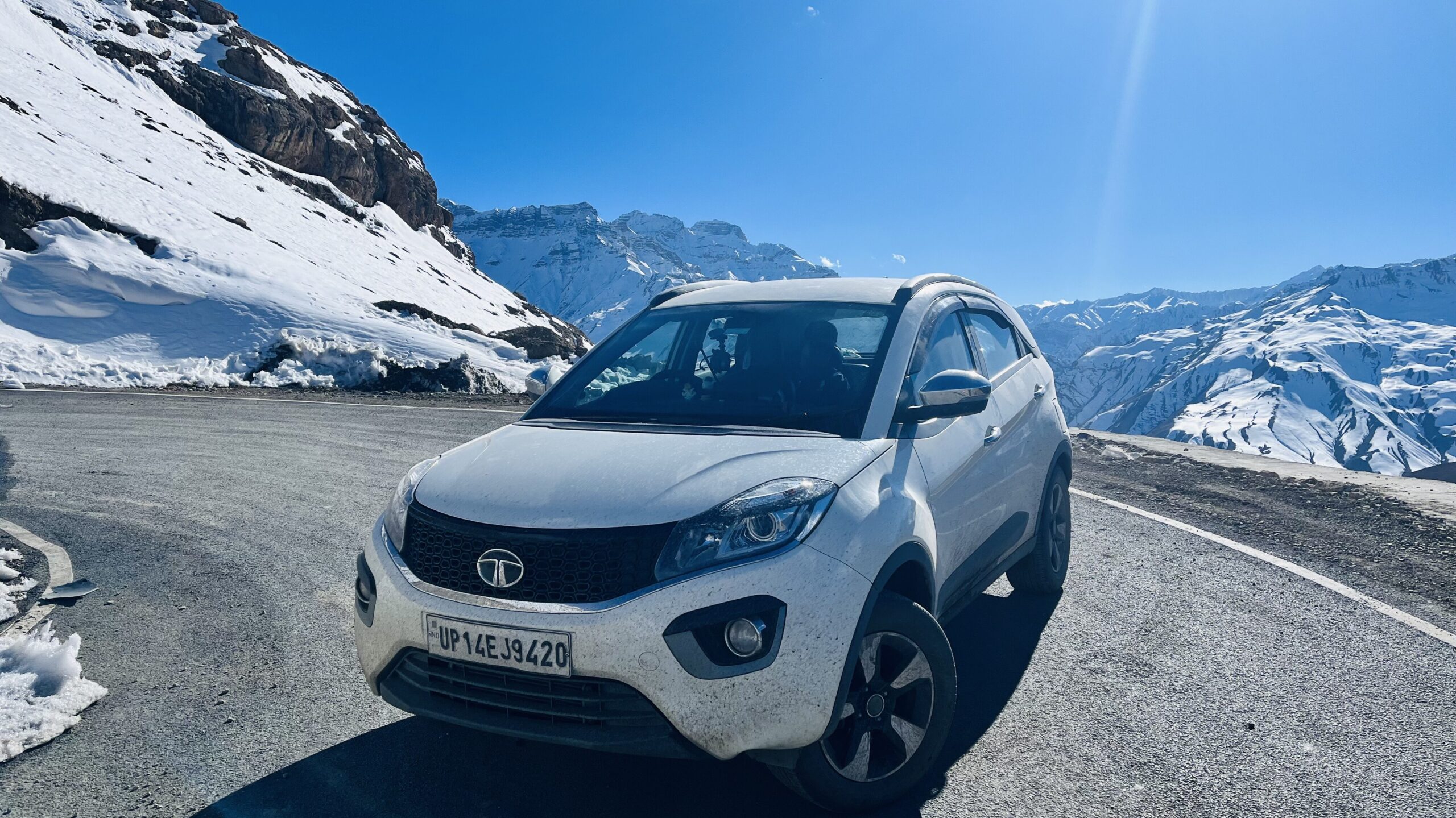
The morning mist hung over Delhi as I tossed the last bag into the car. Seven days—that’s all I’d carved out from my calendar to explore one of India’s most remote and mesmerizing mountain valley i.e. Spiti Valley. The GPS showed 760 kilometers to Kaza, but I knew the real distance was measured in altitude gained, breaths taken slower, and the profound silence that greets you when you’re this close to the Tibet border. This wasn’t just a road trip; it was a pilgrimage to the edges of India.
## Day 1: Delhi to Narkanda – Where the Mountains Begin to Whisper
The first stretch is deceptive. As you leave Delhi’s chaotic embrace behind and head toward Chandigarh, there’s a sense of promise in every kilometer. The Himalayas begin their gentle announcement around Shimla—first as distant silhouettes, then as towering presences that make you crane your neck in wonder.
Narkanda announces itself through apple orchards stretching across emerald slopes. This is the “Apple Bowl of India,” and for good reason. By the time I arrived—around 7 PM after eight hours of driving—the evening light was painting the valleys in shades of gold. The air had that crisp mountain freshness that makes you want to breathe deeper, filling your lungs with something that tastes like freedom.
I checked into a small homestay run by a Himachali family. Over steaming cups of local tea and Himachali bread, the host mentioned the legend of Hatu Peak—the highest point in Narkanda at 11,150 feet. Local folklore says it was a place where the Pandavas once cooked their food during their exile. I’d be climbing there tomorrow.
**Narkanda at a glance:** Altitude 8,000-9,000 feet | Stayed: Local homestay | Cost: ₹1,200/night
—
## Day 2: Narkanda – Where Ancient Myths Touch Modern Souls
Morning came with the sound of birds and the aroma of freshly baked bread. I set out early, determined to conquer Hatu Peak before the afternoon clouds rolled in. The hike takes about an hour from the base, and with each step, the valley below shrinks—a perspective shift that makes your everyday problems seem remarkably small.
At the summit, there’s a wooden temple dedicated to Hatu Mata. The view is unobstructed—snow-capped peaks in every direction, valleys dropping into mist-filled depths, and the wind carrying the kind of silence that feels sacred. A few locals were performing prayers at the temple, and I sat quietly on a rock, watching the world shift colors as clouds moved across the sun.
The afternoon was reserved for Stokes Farm, where the first apple trees were planted in this region over a century ago. Walking through those orchards, hearing stories from the farmer about how apple cultivation transformed these mountains from subsistence farming to prosperity, I understood why apples aren’t just fruit here—they’re cultural identity. I tasted apples plucked fresh from trees, still warm from the sun, with a sweetness that supermarket apples could never match.
By evening, I visited Tani Jubbar Lake—a serene alpine lake surrounded by deodar trees and a small temple dedicated to Nag Devta (serpent god). The reflection of surrounding peaks mirrored perfectly in the still water, so clear that the line between reality and reflection blurred.
That night, sitting with locals at a small dhaba, sharing plates of spiced meat and local momo, I felt the mountain beginning to seep into my bones. There’s something about sitting at 8,000 feet under a sky blazing with stars while listening to stories of this land that changes you.
**Narkanda experiences:** Hatu Peak trek | Stokes Farm | Tani Jubbar Lake | Local cuisine adventure | Cost: ₹3,500
—
## Day 3: Narkanda to Kalpa – Crossing into the Kingdom of Peaks
The drive from Narkanda to Kalpa is approximately 130 kilometers, but it’s not the distance that matters—it’s the vertical climb. As I gained altitude, the valleys grew deeper, the air thinner, and the views more dramatic. The road clings to mountainsides carved seemingly by magic, with drop-offs that would make less experienced drivers nervous.
Then, suddenly, Kinnaur Kailash appeared.
No photograph does justice to this peak. It’s a massive snow-covered Shivling—the unmistakable trident shape of Lord Shiva—rising to 19,850 feet. From Kalpa, it dominates the skyline, a spiritual and visual centerpiece that grounds everything else in the landscape. I stood at the edge of the village, simply staring, for what felt like hours.
Kalpa itself is a revelation. Perched at 9,700 feet, this small village seems frozen in a gentler time. Traditional Kinnauri houses, with their intricate wooden carvings and distinctive architecture, line the narrow lanes. The people speak a dialect blending Hindi and Tibetan, and there’s a palpable harmony between Hindu and Buddhist cultures here.
I stayed at a homestay run by a woman named Tenzin, who served the most incredible momos and butter tea I’ve ever tasted. She showed me photographs of her family’s pilgrimage to Kinner Kailash—a 14-kilometer trek so steep and challenging that even locals consider it a spiritual undertaking. “The mountain chooses who reaches the top,” she said, not metaphorically.
**Kalpa at a glance:** Altitude 9,700 feet | Stayed: Tenzin’s homestay | Cost: ₹1,500/night
—
## Day 4: Kalpa – Among Gods and Mountains
Kalpa demands two days, and I’m grateful I gave them to this place.
Morning began with a visit to Kalpa Monastery (also called Samdub Choeling), founded in the 10th century by Rinchen Zangpo, the master architect who constructed 108 monasteries across this region. The monastery walls are adorned with vibrant murals, and the silence inside—broken only by the rhythmic chanting of monks—feels like it pierces something fundamental in your being. I sat in the main prayer hall for over an hour, watching butter lamps flicker and listening to monks chant texts in Tibetan.
The afternoon was reserved for perhaps the most memorable experience of my trip: climbing to Narayan Nagini Temple, believed to be 5,000 years old and connected to the Mahabharata. The temple is a wooden architectural marvel, with every surface covered in intricate carvings of gods, goddesses, and mythological scenes. The priest welcomed me like family, applied tilak on my forehead, and offered a chunari (sacred cloth) that, he explained, brings blessings from the Goddess.
From the temple courtyard, Kinner Kailash shines with an almost unreal luminescence—especially in the late afternoon when the changing light transforms it from white to gold to a soft lavender.
The real treasure, though, was the walk to Roghi Village. Locals warned me about the narrow, treacherous mountain road—construction was ongoing, and there were indeed sections where the road seemed to disappear into thin air. But the warnings undersold the beauty. Roghi is an ancient village with wooden houses that look like they’ve absorbed the wisdom of centuries. I met an elderly woman collecting firewood, and she invited me for tea inside her 200-year-old house. In broken Hindi and sign language, she shared stories of a life lived between mountains, of seasons of hardship and abundance, of never once leaving this village in eight decades.
The 500-year-old Narayana Temple in Roghi is a jewel—a smaller, even more intricately carved wooden structure that seems to grow organically from the mountainside.
By sunset, watching Kinner Kailash shift through a hundred shades of pink, orange, and purple from Kalpa’s main viewpoint, I understood why ancient yogis chose these mountains for meditation. This place has an energy that feels older than organized religion, deeper than mythology—it’s the earth itself speaking.
**Kalpa experiences:** Kalpa Monastery | Narayan Nagini Temple | Roghi Village trek | Meditation in mountains | Cost: ₹4,000
—
## Day 5: Kalpa to Kaza – Ascending to the Roof of the World
The climb to Kaza is the journey’s dramatic pivot point. At 12,500 feet, Kaza sits in the rain shadow of the Himalayas, in what’s called the “cold desert.” The landscape transforms completely from the green valleys of Kinnaur. You enter a barren, otherworldly terrain—brown and grey mountains with occasional patches of green, sparse vegetation adapted to extreme conditions, and a clarity of air so pristine that distant peaks appear close enough to touch.
The drive takes around 6-7 hours from Kalpa, and altitude gain happens quickly. I stopped at several high passes, forcing myself to walk slowly, breathe deeper, and give my body time to adjust. The locals have a saying: “Ascend gradually, descend quickly.”
Kaza itself is larger than I expected—a proper town with shops, internet cafes, and restaurants, yet maintaining its high-altitude frontier character. I checked into a guesthouse run by a Spitian family and spent the evening simply acclimatizing—reading, sipping butter tea, and watching the sky transition from brilliant blue to a purple-black that no city dweller ever witnesses.
The thin air makes sleep challenging at first, but there’s something clarifying about struggling to breathe at 12,500 feet—it anchors you to your body, to the moment, to the sheer fact of existence.
**Kaza at a glance:** Altitude 12,500 feet | Stayed: Local guesthouse | Cost: ₹1,800/night
—
## Day 6: Kaza – The Trifecta of Spiti’s Treasures
Kaza is the hub for exploring Spiti’s most iconic sites, and I’d allocated two full days to immerse myself in this landscape.
Morning began with Kye Monastery, perched at 13,500 feet and visible from Kaza looking like a fortress carved into rock. The journey there reveals monasteries aren’t just religious structures here—they’re defensive positions, spiritual refuges, and astronomical observatories all combined. The monastery houses hundreds of prayer rooms, dark corridors, and staircases so narrow and low you must duck to pass through them. The monks live a life of extraordinary discipline, and visitors are welcome to observe rituals and participate in prayer sessions.
From Kye, I drove to Komic Village—the world’s highest motorable village at 15,050 feet. The drive is an adventure itself, with roads that seem impossible, switchbacks that make you sweat, and scenery so barren and dramatic that it feels like another planet. Komic has perhaps 20-30 families, and life here is extraordinarily harsh. Yet the people maintain profound kindness toward visitors. A woman offered me tea made from yak butter, and sitting in her modest home, watching her tend to livestock while children did homework by candlelight, I felt the peculiar mixture of hardship and grace that defines these high-altitude communities.
The Tangyud Monastery in Komic, now a museum, holds ancient murals and artifacts. But the real treasure is standing at 15,050 feet, looking across an endless vista of mountains, feeling the reality of where humans have chosen to live and build civilization.
The afternoon was reserved for Chicham Bridge—Asia’s highest suspension bridge, connecting two parts of the valley that would otherwise require a long detour. Walking across it, suspended above a deep gorge with wind howling around you, creates a peculiar meditation on impermanence and human resilience.
As evening fell, I drove to Langza Village to witness the Golden Buddha statue, lit with the last rays of sunlight. The statue glows against the barren landscape—a spiritual landmark visible from miles away. The 500-year-old temple nearby adds historical depth to a spot that feels simultaneously ancient and timeless.
**Day 6 experiences:** Kye Monastery | Komic Village (15,050 ft) | Chicham Bridge | Langza Golden Buddha | Cost: ₹3,000 (shared jeep, food)
—
## Day 7: Kaza to Sangla via Gue – The Mummy, the Last Village, and the Circle Complete
The final day is a loop that brings you back toward civilization while visiting Spiti’s most enigmatic locations.
First stop: Gue Village, famous for one of India’s most remarkable—and eerie—attractions. Gue is home to the 500-year-old mummy of Sangha Tenzin, a Buddhist monk who supposedly underwent a form of spiritual suicide to save his village from a plague of scorpions. The mummy, preserved naturally through the monk’s extreme austerities and the dry mountain climate, is kept in a glass chamber in Gue Monastery. Seeing it is genuinely unsettling—you’re looking at a human who lived five centuries ago, skin intact, teeth visible, preserved by an act of devotion.
The monastery itself is modest but spiritually potent. The murals and thangka paintings inside tell stories of compassion, enlightenment, and the Buddhist view of death not as ending but as transition. Local monks were there when I visited, and they explained the philosophy behind what Sangha Tenzin did—not as suicide but as ultimate compassion, choosing death to protect others.
From Gue, the road to Sangla winds through increasingly green terrain, a dramatic shift from Spiti’s desert. Within a few hours, you transition from the cold desert to the lush Baspa Valley.
Sangla announces itself through apple orchards and towering deodar forests. This is the heart of Kinnaur’s fruit belt, and a gentler mountain experience than high-altitude Spiti. Kamru Fort, perched above the village, is one of the region’s oldest structures—a small fortress with views that encompass the entire valley.
But the true finale awaits: Chitkul.
—
## The Final Stop: Chitkul – India’s Last Village
Chitkul is only 23 kilometers from Sangla, but the road gets progressively narrower, rougher, and more thrilling. You’re climbing to 11,000 feet, following the Baspa River through increasingly dramatic gorges. The final section would be impossible to drive during winter, and even in autumn, the road demands respect.
Then you arrive at what’s been called “India’s Last Village”—the final inhabited settlement before the Indo-Tibet border, the last place of Indian civilization before the wilderness of Tibet begins.
Chitkul is small, perhaps 20-30 families, built on terraces above the Baspa River. The houses are traditional Kinnauri architecture—wooden frames with intricate carvings, some over 200 years old. The river roars below, glacial meltwater intensely green-blue from minerals, and the surrounding peaks are permanently snow-covered.
The main landmark is Akhri Dhaba—literally “the Last Dhaba on the Indo-Tibet Road.” Eating lunch there, with views of the Kinnaur Kailash and the Baspa River gorge, feels like dining at the edge of the world. The dhabawan (dhaba owner) told stories of trekkers from across the globe who come specifically to eat at the last dhaba on the road to Tibet. There’s something profoundly moving about that—this small structure serving simple food at the literal edge of India’s territory.
I walked along the Baspa River, scrambled among rocks, visited the small Mathi Temple, and simply sat for hours watching the river flow toward the lowlands, toward civilization, toward the world I’d left behind.
The thing about Chitkul is that it doesn’t feel like a destination you’ve reached—it feels like the last breath before departure. You’ve come as far as you can go, and tomorrow you must turn back.
—
## The Return Journey
The drive back from Chitkul to Sangla, then Kalpa, then eventually to Delhi takes two full days of driving. But it’s different now. You’re not chasing views anymore; you’re carrying them within you. Every mountain pass you reascend has become familiar. The thin air no longer makes you lightheaded—it makes you present.
Somewhere between Kalpa and Narkanda, watching the landscape transition from cold-desert browns to apple-orchard greens to the humid forests approaching the lowlands, I realized something fundamental had shifted. I’d left Delhi as a tourist. I was returning as someone who’d stood at India’s edge and looked across at the vastness beyond.
—
## Practical Essentials for Your Journey
**Best Time to Visit:** April to June offers clear skies and comfortable temperatures (5-20°C). September to October brings stunning autumn colors. Avoid November to March if traveling from Manali (roads close); the Shimla route remains accessible but extreme cold makes conditions challenging.
**Accommodation:** Budget ₹1,500-3,000 per night for good homestays. Book in advance during peak season (May-June, September-October). Homestays offer immensely better experiences than hotels.
**Altitude Acclimatization:** Ascend gradually. Spend an extra day in Narkanda and Kalpa. Drink plenty of water, avoid alcohol initially, and don’t rush. Altitude sickness is real but manageable with patience.
**Road Conditions:** The Shimla-Kaza route is better maintained than the Manali route. Roads can be narrow with occasional landslide risks. Self-drive or hire experienced local drivers. Inner line permits aren’t required for Indian nationals.
**What to Pack:** Layered clothing (mornings are freezing, afternoons can be warm), sturdy trekking shoes, sunscreen, lip balm, power banks, and reusable water bottles. Download offline maps of areas with poor connectivity.
**Budget (Daily):** ₹2,000-3,500 including accommodation, food, and local transport. Fuel costs if driving from Delhi approximately ₹5,000-7,000 for the round trip.
**Food:** Embrace local Himachali cuisine—momos, thukpa, local meat dishes. Street food is generally safe, and homestays serve authentic meals. Carry snacks for high-altitude areas where restaurants are sparse.
—
## Final Reflections
Seven days in Spiti Valley isn’t enough. No amount of time would be enough. But it’s enough to touch something essential—to understand that mountains aren’t just landscape, they’re consciousness. They teach you something about scale, about human resilience, about the simultaneous vastness and intimacy of existence.
When you stand at Chitkul, looking toward Tibet, or sit in a monastery at 13,500 feet listening to monks chant, or taste apples that have grown in centuries-old orchards, you realize that travel isn’t about collecting experiences. It’s about being changed by them.
The mountains of Spiti have a way of lingering in your bones long after you’ve returned to sea level. You carry the silence, the clarity of purpose that comes from thin air and vast horizons, and the quiet knowledge that you’ve touched the edge of something infinite.
Pack light, climb high, and let the mountains teach you what they’ve been waiting to share.
—
**Have you explored Spiti Valley? Share your stories in the comments—every traveler adds another layer to these mountains’ eternal narrative.**